
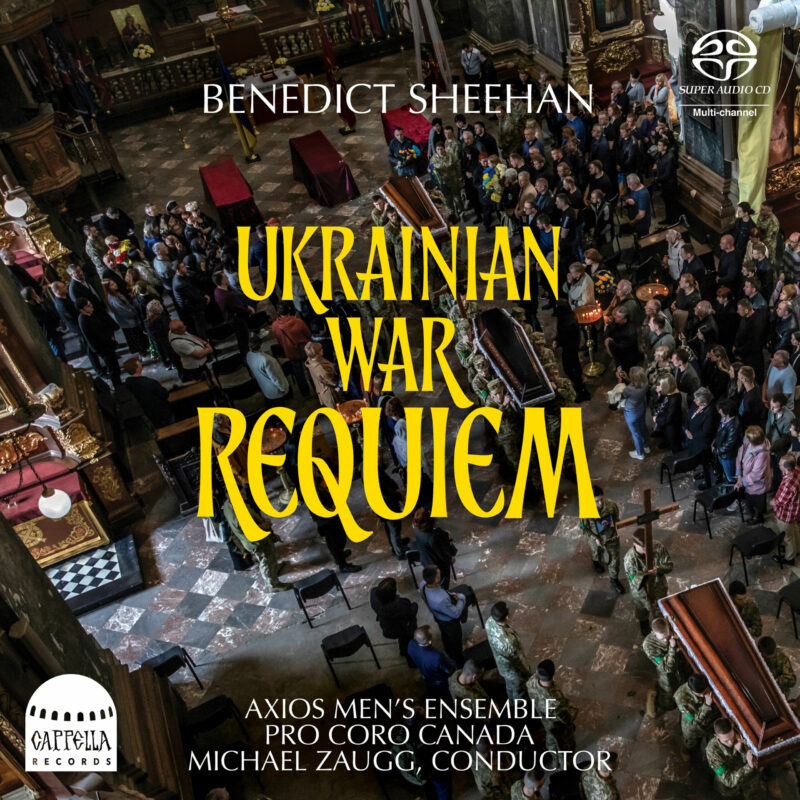
Sheehan set a high bar with Ukrainian War Requiem. He succeeds in drawing from various chant traditions and creating new ones by bringing an original sound to life. The work’s greatest accomplishment is its authenticity. Anchoring his work on the architecture of the panakhyda, Sheehan succeeds in delivering a piece that challenges its performers and creates numerous moments of tension, inspiration, and wonder, and yet somehow sounds like church. Sheehan aimed to represent Ukraine’s “big tent” of religious and musical traditions, and Zaugg’s conducting holds the tent together. Some might balk at the setting’s mosaic-like features, especially the use of three languages. English is not used frequently by Ukraine’s religious communities, and none of the movements are set to Church Slavonic. Using Ukrainian instead of Slavonic confirms the evolving reality of Ukrainian religious life: most of Ukraine’s Orthodox and Greek Catholic communities now worship in modern Ukrainian. The use of English reveals an intent to enlighten North Americans in particular on Ukrainian suffering. The inclusion of Latin hymns honors Ukraine’s long encounter with the Catholic West. Those who hear these native sounds in three different languages learn about Ukraine’s big tent of religious and linguistic plurality.
Sheehan succeeds in expressing the most important truth about Ukraine: the citizens of this country are in the process of deciding who they are, a journey of unimaginable sacrifice, unjust violence, and death. Sheehan’s masterful moments of unresolved musical tension illuminate war-torn and occupied Ukraine as a space where lament and hope meet.
Art becomes beautiful and serves humankind when it inspires beholders to learn through engagement of the artist and the community they represent—through the art, and also through the people themselves. Let there be no doubt that Sheehan’s Ukrainian War Requiem succeeds as beautiful art that teaches, inspires, and moves hearts.